I just found and watched a movie called
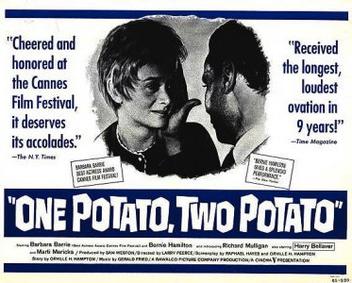
One Potato, Two Potato (1964).
This movie pushed the envelope more than
Guess Who’s Coming to Dinner (1967) and was released three years earlier!
https://en.wikipedia.org/wiki/One_Potato,_Two_Potato
In an early example of "crowd funding," the $230,000 budget for
ONE POTATO, TWO POTATO was supplied by approximately fifty private investors, mostly from New York City, who contributed as little as $500.
Photography was completed over a period of thirty-four days.
No U.S. distributor was willing to handle the film, except for an unidentified major company, which declined after the producers refused to add a “cheerful” ending. Others anticipated a lack of interest from Southern exhibitors.
Director Larry Peerce, son of opera singer Jan Peerce, told the 13 July 1964
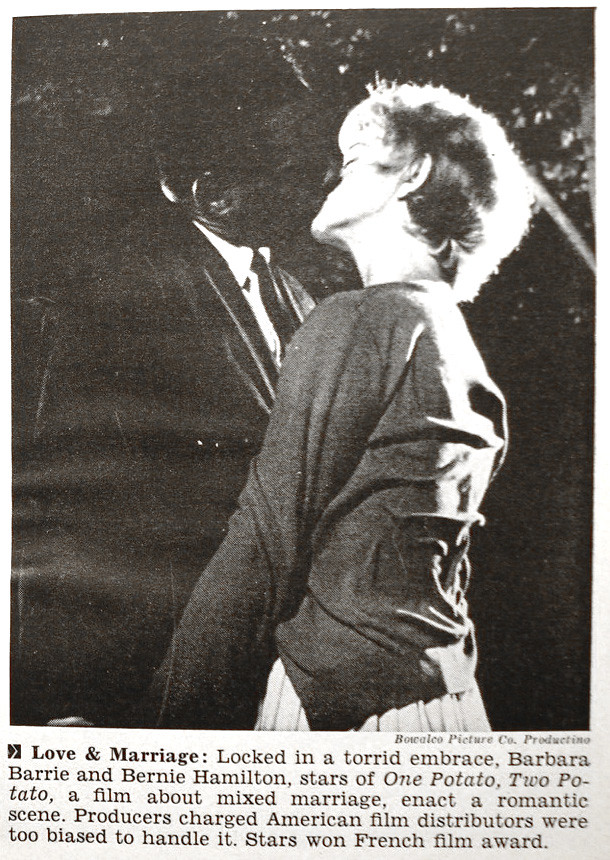
New York Times that he also offered the picture to the U.S. selection committee for the Cannes Film Festival. The three committee members who agreed to view the picture, Fred Zinneman, George Stevens, Jr., and Allen Rivkin, walked out after thirty minutes. Producer Sam Weston believed the scene in which Barbara Barrie kissed her African American co-star, Bernie Hamilton, was “too much” for them. While Peerce was seeking distribution in Europe, the selection committee in Cannes, France, agreed to screen the film at their upcoming festival, where it received a five-minute standing ovation, and won a best actress award for Barbara Barrie. Weston and Peerce recovered their production expenses after receiving an advance on royalties from overseas distributor British Lion Films.
The film opened 29 July 1964 at the Murray Hill Theatre in New York City. Openings followed at the Orpheum Theatre in Los Angeles, CA, and at the Beverly Cañon Theatre in Beverly Hills, CA, on 27 August 1964. Bernie Hamilton appeared at debuts in New York, London, and Paris. Reviews were mixed: While the the 9 September 1964
Los Angeles Times complained about the film’s lack of professionalism, the 8 May 1964
Daily Variety called it “a tactful look” at interracial marriage, and the 27 December 1964
New York Times listed it among the ten best releases of the year.
U.S. distributor Cinema V anticipated gross receipts of $1 million, with exhibitors from Virginia, Louisiana, and North Carolina bidding for the film. Out of the 250 Southern theaters that screened the film, only thirty to forty did not have an exclusively African American clientele. The film was very popular in Japan, where it was considered a compelling melodrama, rather than an exploration of U.S. race relations, of which the Japanese had reportedly little understanding.
Released three years
before Guess Who’s Coming to Dinner (1967), and one year before the Voting Rights Act (1965), One Potato, Two Potato (1964) is about a white divorced woman who falls in love with and marries an African-American man. When her ex-husband sues for custody of her child, arguing that a mixed household is not a proper place to raise the child, the new African-American husband had to fight for his parental rights in court, fighting against a judge who represents the prejudices of the era.
Directed by Larry Peerce and shot in its entirety in and around the small northeastern Ohio city of Painesville, “One Potato, Two Potato” received all the cheers for displaying such emotional and political courage in telling the stories of interracial couples.
Lead actress, Barbara Barrie, for her role as Julie Cullen Richards,
won the Best Actress award at the 1964 Cannes Film Festival.
The screenplay, written by Orville H. Hampton and Raphael Hayes, was also
nominated for Best Original Screenplay at the 1964 Academy Awards.
Full movie via Youtube: